
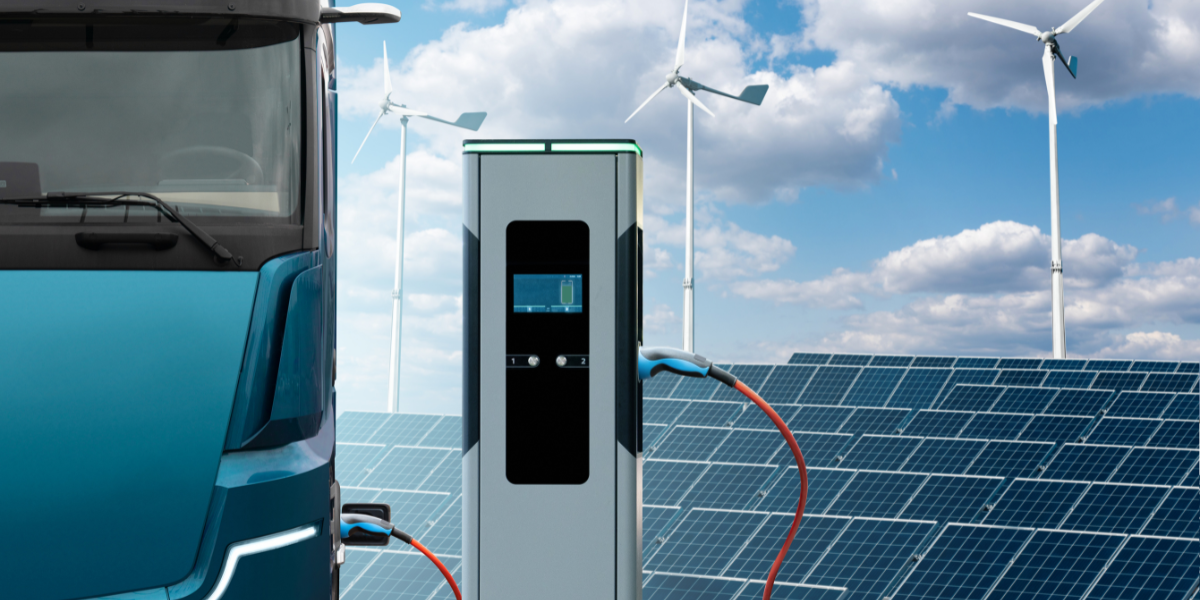
Electricity production, storage, and consumption are today increasingly based on direct current (DC). The transfer of DC offers several technical and economic advantages, especially in environments with high power demands.
As part of its technological work, the Bothnia Green Energy project has explored the potential of DC solutions. In spring 2025, AFRY conducted a techno-economic feasibility study aimed at analysing the conditions for local DC grids in two practical applications: a parking facility for Umeå Parkering AB (UPAB) and an industrial charging solution at Alholmen Industrial Park (AIP) in Jakobstad.
The study examined how DC solutions could be applied in each case, and what benefits they might offer compared to conventional AC solutions – particularly in supplying power and energy for electric vehicles.
The results consist of two parts:
- An open Excel-based calculation tool, where users can input their own conditions to compare the performance and economics of DC and AC solutions. The tool also allows optimisation of system sizing, such as solar PV and battery storage.
- A report presenting the analysis and research questions from a qualitative perspective. The report is publicly available to everyone.
Key findings from the feasibility study:
- Higher system efficiency – At high loads and with extensive charging, DC systems can reduce energy losses by 2–5 percentage points compared to AC, and cut losses by up to half when solar power is stored in a battery before being used for charging.
- Greatest benefits in heavy-duty charging – The industrial area case shows that with high energy throughput, operating costs dominate, and DC solutions become more cost-effective over time, particularly for heavy traffic and industrial vehicles.
- Economically equivalent at lower loads – In the parking facility case, the difference in LCOE between AC and DC is small, but DC can simplify future expansion and solar PV integration through a shared central inverter.
- Solar integration benefits – With high self-consumption of solar power, DC systems have a clear advantage by avoiding unnecessary conversion steps, increasing the share of utilised solar power and shortening the payback period.
- Scalability and robustness – A DC grid can be easily expanded as demand grows, automatically distributing power where it is most needed. This ensures stable operation even at high loads and provides more reliable performance.
Key terms:
- DC (Direct Current) – Electricity that flows continuously in one direction, e.g. in batteries and solar panels.
- AC (Alternating Current) – Electricity that changes direction many times per second (50 Hz in the Nordics), standard in power grids.
- LCOE (Levelized Cost of Energy) – The average cost per produced kWh over a system’s lifetime, including investment and operation.
- Central inverter – A larger unit that converts DC from e.g. solar panels or batteries to AC or vice versa, and can be shared across functions.
- Conversion step – When electricity is converted between AC and DC or between different voltage levels; each step results in small energy losses.
The results confirm the project’s original hypothesis: there are strong reasons to apply DC as a solution for future charging infrastructure, especially in high-power environments. As electrification advances, the economic benefits of DC will increase, and wider application could also ease pressure on the national transmission grid.
The next step in the Bothnia Green Energy project is to evaluate the results of the study, draw conclusions, and identify concrete applications where DC technology can contribute to energy savings and a more robust power system.
