How is the Jakobstad region performing in today’s turbulent global environment? What development trends can be identified, and what has changed in recent years? Do decision-makers, public officials, and business leaders have access to the factual data they need? And can the region’s strengths be confidently presented when engaging across Finland and internationally?
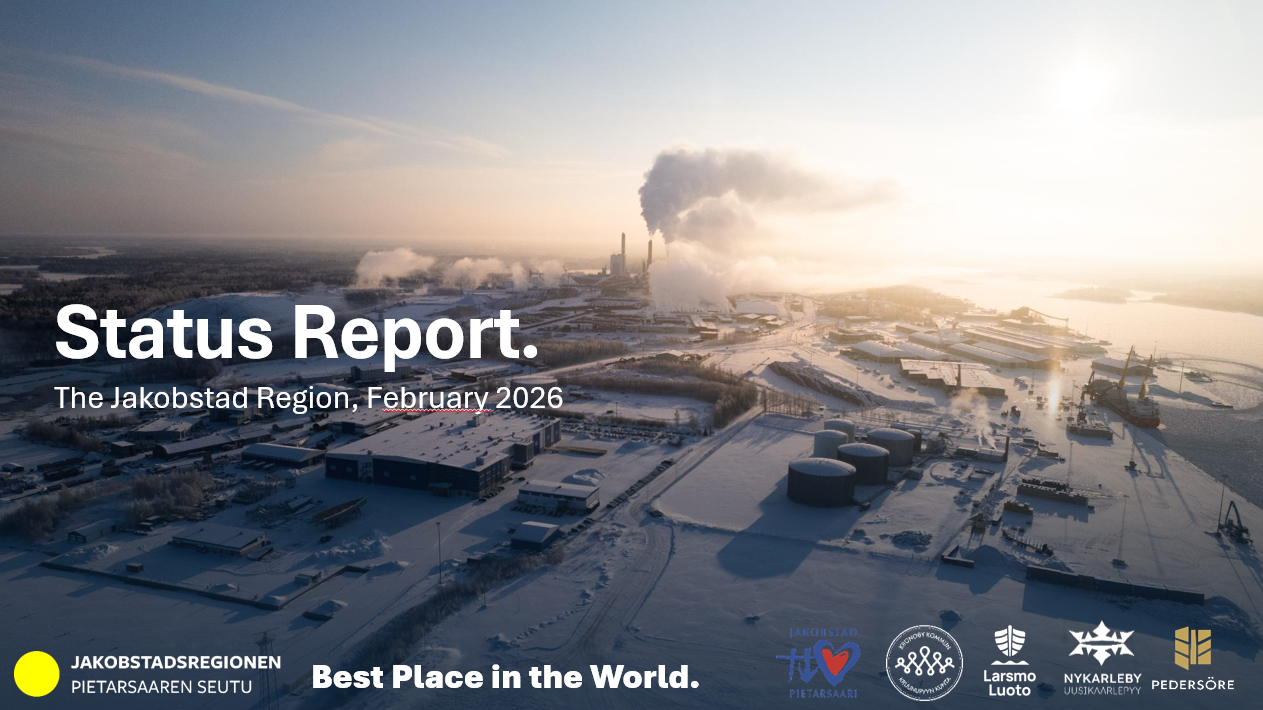
The answers to these questions are provided in the newly released Status Report 2026.
The report has been further developed and deepened, with a particular focus on the business and economic landscape. The publication is structured around four main themes:
- Key figures and population development
- Business and economy
- Labour market
- Logistics and infrastructure
Positive growth signs in the region
The Jakobstad region continues to show positive growth, even though the record-breaking in-migration seen in 2023 has levelled off somewhat. Population growth is still driven primarily by international, work-related immigration. The regional business sector remains strong, with increases in turnover, profits, and employment.
A diverse industrial base and a strong export-oriented manufacturing sector, supported by extensive and flexible subcontracting networks, remain key competitive advantages. With a total turnover of €4.76 billion, the region delivers strong economic performance relative to its population of just over 50,500. Rather than relying on a single dominant company, the region’s economy is driven by what is often described as “seven strong carriages instead of one locomotive.”
The food industry remains the largest employer, while the paper industry leads in terms of turnover. When all subsectors (TOL) of the metal industry are combined, metal manufacturing also ranks among the region’s strongest industries. Close behind are the boat and composites sector, plastics, abrasives, and machinery manufacturing. One notable growth sector is construction, which is currently seeing clear increases in turnover, employment, and the number of companies, despite a challenging market environment.
Need for further investments and support
In recent years, significant investments have been made in logistics and infrastructure, including roads, bridges, ports, railways, and air transport. However, the need for further investments to support business development, population growth, and continued positive momentum remains substantial, making ongoing advocacy and lobbying efforts essential.
At the same time, several development challenges have been identified. Value added and gross domestic product per capita have unfortunately shown a downward trend, and productivity development remains a concern—both for the region and for Finland as a whole. These issues require closer analysis.
Labour market indicators point to higher unemployment during the final quarter of 2025, alongside an increase in temporary layoffs. Despite this, the Jakobstad region continues to record the lowest unemployment rate on the Finnish mainland. The primary challenge lies in matching jobseekers with the skills and profiles required by employers. Should the economic cycle turn or a major new investment materialise, labour shortages are likely to re-emerge very quickly.
All of this and more can be found in the newly published Status Report 2026, now available online.
For those in need of statistical data, further information is readily available. Municipality-level and industry-specific data can be compiled quickly from most sources. We are pleased to present the Status Report 2026 and the development of the Jakobstad region in various forums and events upon request—naturally, in all three languages.
Fredrik Sandelin, Regional Developer
fredrik.sandelin@concordia.jakobstad.fi
044 324 3435